
Fan cooling garments
Brushless fans move air across the torso and under the outer layer. Hi-vis and reflective versions are built for site work, so cooling and visibility come in one garment.
- Runtime
- 8-12 h at low speed
- Power
- 12 V DC as specified
- Typical use
- Full shifts, delivery fleets and site crews where it fits
Water circulation cooling
Chilled water is pumped through a close-fitting loop against the skin. The heaviest duty of the seven, and the only one that pulls heat away from the body instead of storing it.
- Runtime
- 4-8 h per reservoir fill
- Power
- 12 V DC as specified
- Typical use
- Foundry and construction floors, radiant heat where it fits
PCM phase-change cooling
Frozen phase-change packs absorb body heat at a constant temperature. No power, no pump, and the packs are re-frozen between shifts in any standard freezer.
- Runtime
- 2-4 h per frozen set
- Power
- Passive as specified
- Typical use
- Battery-restricted areas, kitchens, rescue teams where it fits
Peltier cooling vests
A semiconductor plate moves heat from the back panel to a heat sink. Reversing the polarity turns the same garment into a heated work jacket for cold shifts.
- Runtime
- 3-5 h on battery
- Power
- 12-24 V DC as specified
- Typical use
- Confined spaces, welding and workshop benches where it fits
Evaporative cooling vests
Water-soaked fabric cools by evaporation. The lightest and lowest cost route, and the only one that needs no battery, no pump and no ice.
- Runtime
- 4-6 h per fill
- Power
- Passive as specified
- Typical use
- Dry heat, farming, fishing and outdoor events where it fits
Battery and fan kits
Complete kit format: a lithium pack, a controller and brushless fans, from 12 V up to 50 V. Bought when the fan or the coolant has to run independently of the garment.
- Runtime
- 8-12 h per pack
- Power
- 12-50 V DC as specified
- Typical use
- Mobile cooling, remote sites and vehicle fleets where it fits
New design line
This season shell designs, including the dual-mode vest that switches between evaporation and forced air, plus the 36 V and 50 V battery range.
- Runtime
- 4-10 h varies by model
- Power
- 12-50 V DC as specified
- Typical use
- Buyers who need the newest shell and battery range where it fits
Selection
Pick the route by heat load, not by catalogue
Heat arrives in three ways on site: radiant heat from a furnace or an asphalt pour, conductive heat through protective clothing, and humid air that stops sweat evaporating. Each defeats a different technology, which is why most projects end up with two systems rather than one.
- Above 45 °C radiant heat — water circulation, because airflow alone cannot remove the load.
- Battery restricted area — PCM packs, re-frozen between shifts.
- Humidity below 40% — evaporative, the lightest and lowest cost route.
- Shift longer than 6 hours — fan kit with a 20,000 mAh pack, or a second reservoir.
| Condition | System | Runtime |
|---|---|---|
| Foundry floor, 50 °C | Water | 4-8 h |
| Fire rehab, no power | PCM | 2-4 h |
| Welding, confined space | Peltier | 3-5 h |
| Roofing, dry heat | Evaporative | 4-6 h |
| Site crew, full shift | Fan | 8-12 h |
| Variable day/night exposure | Water + fan | 4-12 h |
Manufacturing technology
Manufacturing Technology for Cooling and Heating Products
We build products using four core technologies: phase-change material, electric heating elements, fan cooling and water-circulation cooling. Each is produced or assembled in-house and can be specified or customized by the buyer at the product-development stage.
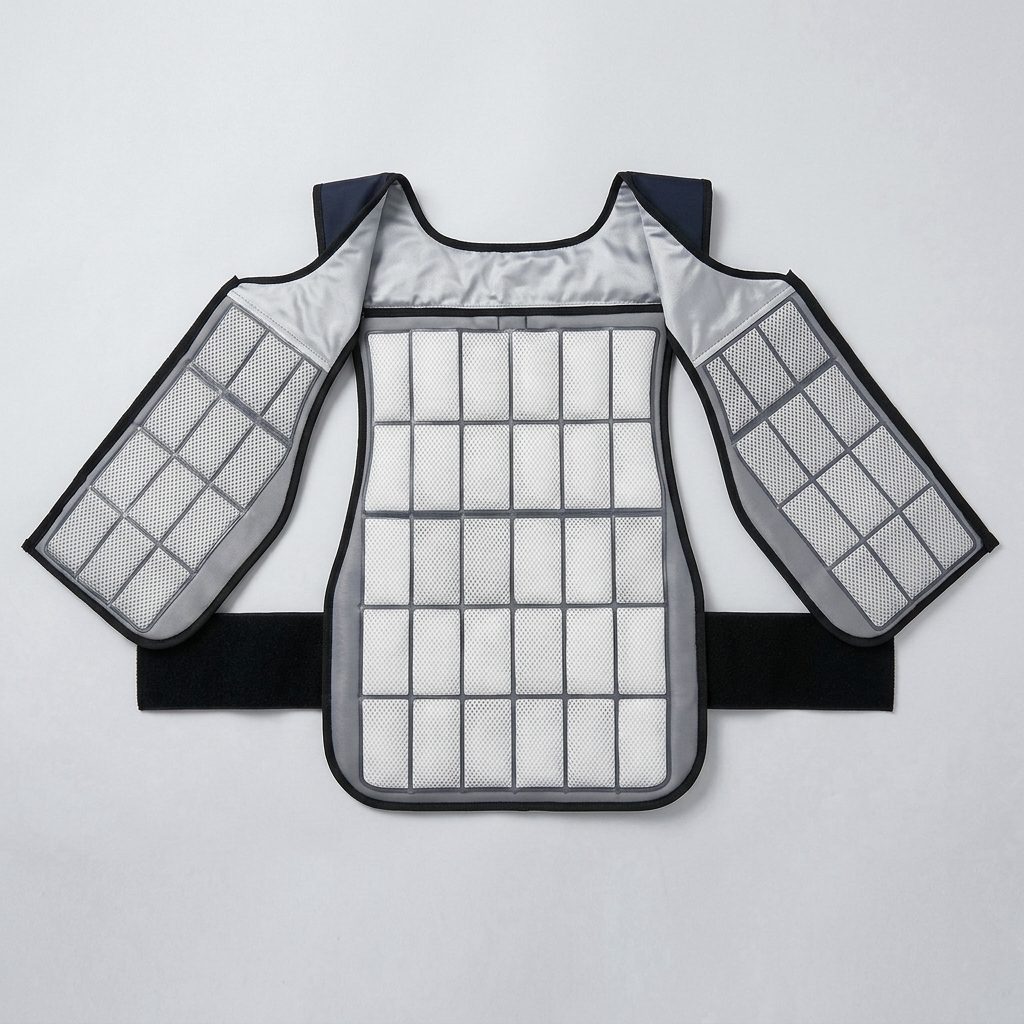
Phase-change material
PCM cooling that needs no power
Phase-change material absorbs body heat as it melts and releases it again when the wearer cools down. No battery, no motor and no water circuit, which makes it the easiest route to specify for sites where powered equipment is restricted.
- Working principle: encapsulated PCM packs melt at a set phase point and absorb latent heat.
- Where it fits: dry heat, long shifts and sites where batteries are not permitted.
- Customisation: pack density, phase point and pocket layout are set at development stage.
- Trade-off: cooling stops once the packs are melted, so an air flow is needed for extreme radiant heat.
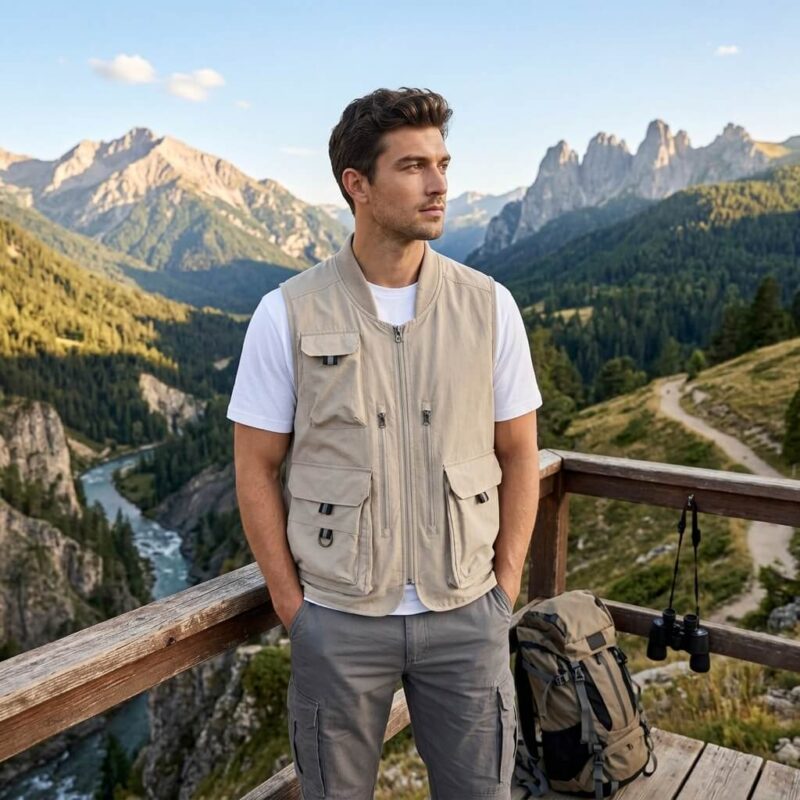
Electric heating elements
Heated apparel for cold and night shifts
Carbon-fibre heating zones are driven by the same intrinsically safe battery packs we build for cooling, so one platform covers both cold sites and hot climates without changing supplier, paperwork or spare parts.
- Working principle: resistive carbon-fibre elements in chest, back and pocket zones.
- Where it fits: cold storage, winter construction and early-morning or night work.
- Customisation: zone layout, wattage, temperature steps and battery runtime.
- Certification: battery packs are tested for intrinsic safety before they leave the plant.
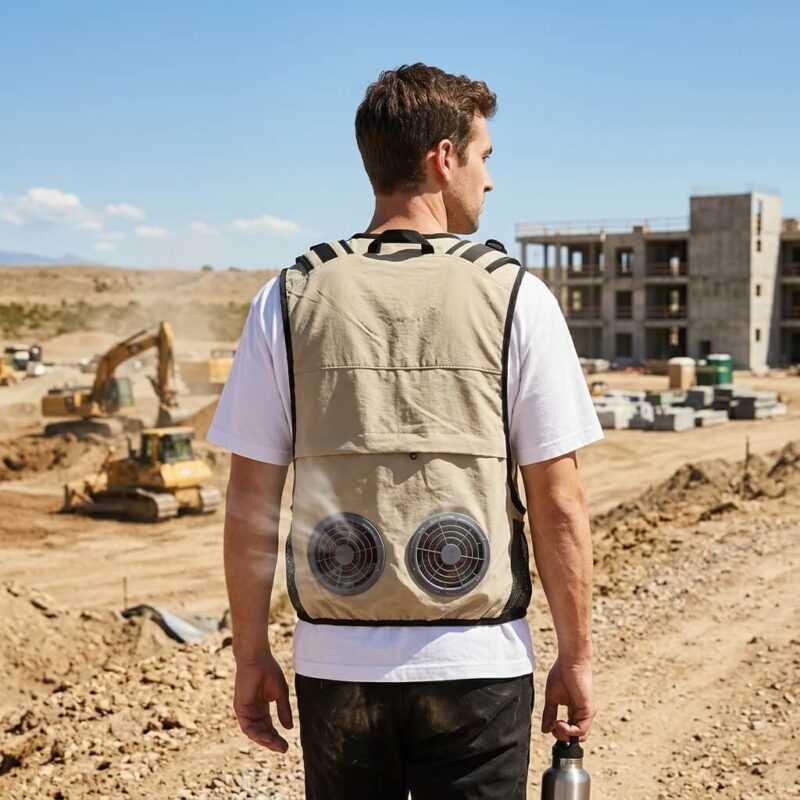
Fan cooling
Air movement for the hottest body zones
Brushless fans move air across the torso and under the outer layer. It is the simplest route to specify when a site cannot run a water circuit, and the most flexible one for a first trial order.
- Working principle: high-speed brushless fans with low-noise bearings and sealed housings.
- Where it fits: warehouses, commercial kitchens, construction and delivery work.
- Customisation: fan count, position, speed steps and battery capacity.
- Trade-off: runtime depends on battery capacity and duty cycle, so runtime is quoted with the model.
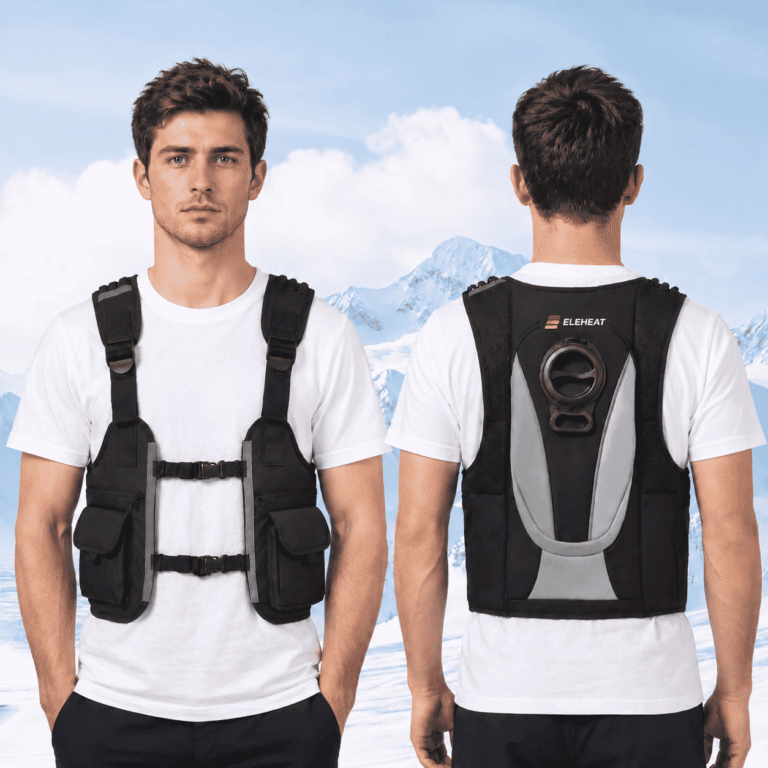
Water-circulation cooling
Continuous cooling from a chilled water circuit
An insulated reservoir and low-profile pumps circulate chilled water through the garment and back to the tank, giving steady cooling for as long as the reservoir holds cold. This is the route chosen when runtime matters more than weight.
- Working principle: insulated reservoir, low-profile pumps and channeled tubing inside the garment.
- Where it fits: long shifts in high heat, where a full shift of cooling has to be guaranteed.
- Customisation: reservoir size, pump output, ice pack type and tubing routing.
- Maintenance: reservoir and tubing are laid out for field cleaning and refilling.
Peltier cooling and evaporative cooling are also available as complete systems — see the full catalogue.
A manufacturer of cooling and heating wearables,
not a trading company
ELEHEAT designs and produces cooling vests, heated workwear and the power systems that drive them in our own 12,000 m² plant in Dongguan, China. Garment, cooling circuit and battery pack are developed by one engineering team and assembled under one quality system, so a specification written for your site stays valid from the first sample to the bulk order. Private label programmes, custom sizing and target-market certification are handled inside the same building, with a single account manager from the first enquiry to delivery.
View MoreNext step
Looking for the right cooling solution?
Tell us your application, target market and requirements. Our team will help you find the right cooling garment for your needs.
Replies during China working hours (GMT+8). Specification files in PDF or Excel are welcome.