Cooling Vests for Delivery Riders and Couriers
This page is for fleet managers, dispatch leads, and safety officers running two-wheeler couriers, loading dock staff, and last-mile drivers. The shift is a series of short stops rather than one long task: the rider moves between a hot street, an unshaded cargo box, and a stairwell, then repeats the loop. Cooling has to survive that stop-start pattern, fit under a company uniform, and stay clear of the hands when parcels are carried.
Why heat is a problem in this work
Two-wheeler couriers absorb heat from the road surface, the engine, and direct sun, often while wearing a branded jacket and a full-face helmet. A helmet traps heat around the head, which removes much of the body’s ability to lose heat through the scalp. Loading adds a second load: a parcel van or cargo box holds interior air well above street level, and the courier steps from that box into traffic within seconds.
The stop-start pattern is the specific difficulty. A rider who is moving gets air flow; a rider waiting at a signal, a loading bay, or a building lobby does not, and core temperature climbs during those pauses. An eight to twelve hour shift also means the cooling system must be rechargeable in the vehicle or swappable from a spare, not tied to a single charge or a single fill.
Which cooling system fits
| Working condition | Recommended system | Why | Runtime |
|---|---|---|---|
| Continuous road riding, long shift | Battery fan kit | Air flow under the jacket, no water supply | 8-12 hours at low speed |
| Frequent stops at signals and lobbies | PCM cooling vest | Packs keep cooling when airflow stops | 2-4 hours per set |
| Loading dock and cargo box transfer | Water circulation vest | Sustained cooling during static loading | 4-8 hours per fill, about 4 hours at 35 C |
| Dry hot climate, no charging point | Evaporative cooling vest | No draw on vehicle power | 4-6 hours per fill |
What crews actually wear
Couriers usually wear a low-profile vest under the company shirt, with the battery or reservoir in a belt pouch so it does not press into the backrest. Riders keep one spare pack in the top case and swap at the depot mid-shift. For loading crews, a water circulation vest is worn through the dock block and taken off before the road loop starts. Two vests per rider cover a full shift without a wash cycle between them.
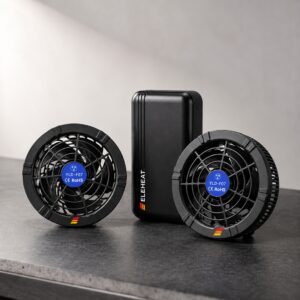
- Battery fan kits for full-shift road riding where a water supply is not practical.
- PCM cooling garments for riders who stop often and lose airflow.
- Water circulation cooling garments for dock and cargo box work.
Frequently asked questions
Will a cooling vest fit under a courier jacket and back protector?
Most vests are cut with a flat back panel, so a motorcycle jacket and a back protector fit over them. Check shoulder and armhole clearance with full layering on. Riders who carry a parcel bag on the back often move to a battery fan kit, which sits lower and adds little bulk at the spine.
How long does cooling last across a twelve-hour shift?
No single system covers twelve hours on one fill or charge. A battery fan kit runs 8-12 hours at low speed, a water circulation vest 4-8 hours per fill, and PCM packs 2-4 hours per set. Plan one swap at the depot and keep the spare in the top case.
Does a cooling vest work in a humid climate?
Evaporative vests lose effectiveness as humidity rises, because water evaporates more slowly. In humid conditions choose water circulation or PCM, which remove heat by conduction instead of evaporation. Peltier vests are also an option where a 20,000 mAh pack is practical.
Can we order in fleet quantities with our own logo?
Stock models start at 50 sets. Custom color and logo orders start at 200 sets. Samples take 7-10 days and bulk production 25-35 days. Battery and fan parts carry a 12-month warranty, and our 12,000 m2 factory with 700 staff works to an ISO 9001 quality system. Timing details are on our FAQ page.
Tell us your shift length, climate, and fleet size, and we will propose a vest and battery combination for the route.
Models for this scenario
Recommended products
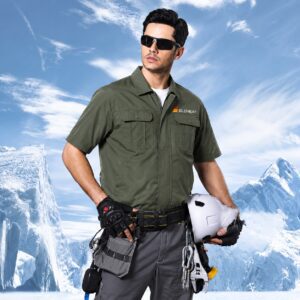
12V Boost Cable Air Conditioned Vest for Men, Summer Cooling Fan Workwear, Single Top
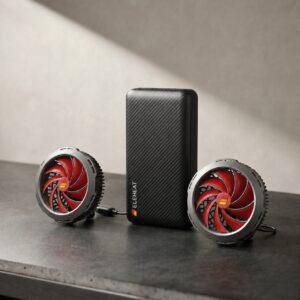
24V Cooling Garment Battery Fan Set | 30000mAh, 9-Blade Silent Brushless Fan CE Certified
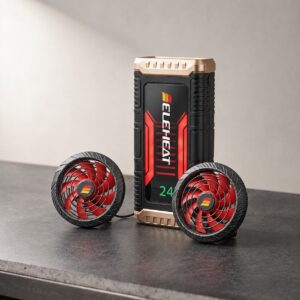
24V High Speed Brushless Fan & Battery Accessories Kit for Cooling Work Clothes
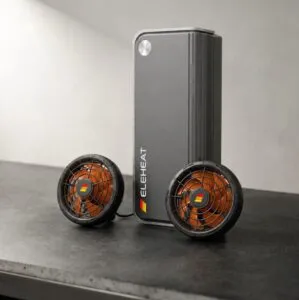
24V Special Battery Fan Kit for Cooling Work Clothes, 4 Speed Silent Brushless Waist-hung Fan
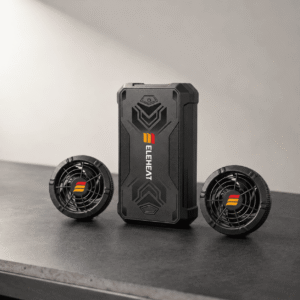
30V 24000mAh Lithium Battery Kit | Powerful Brushless Fan for Cooling Work Garments