Cooling Vests for Outdoor Leisure and Sports
This page is for organizers, guides, rental operators, and teams buying cooling workwear for outdoor leisure and sports in hot weather. It covers hiking groups, cycling tours, camping crews, and summer event staff who spend six to ten hours in direct sun, often with limited shade or power. The problem is not only air temperature. Radiant heat from pavement and rock, humidity that blocks sweat evaporation, and long continuous exposure without a cool recovery period all raise core temperature.
Why heat is a problem in this work
In open ground the body absorbs solar radiation on top of the air temperature, and dark clothing raises skin temperature further. Hiking and cycling add metabolic heat from sustained effort, so core temperature climbs faster than the weather alone would suggest. Shade is intermittent, and a route often has no cooling station. Because sweat only cools the body when it evaporates, high humidity in coastal or pre-storm conditions removes that natural defense and leaves crews wet, hot, and slow to recover between sections.
Event marshals and campsite staff face a different version of the same problem: low physical load but eight to twelve hours standing on hard reflective surfaces. Uniform rules, hi-vis layers, and radio harnesses trap heat and block airflow along the back. Power and ice logistics then matter as much as the garment itself, because a system that runs four hours cannot cover a full shift without a spare set or a planned recharge.
Which cooling system fits
| Working condition | Recommended system | Why | Runtime |
|---|---|---|---|
| Multi-hour hiking route, no resupply | Water circulation vest | Continuous cooling without battery weight | 4-8 hours per fill, about 4 hours at 35 C |
| Cycling support, moderate effort | Evaporative cooling vest | Light, no power to manage, uses airflow | 4-6 hours per fill |
| Fixed post or campsite duty | Battery fan kit | Steady airflow for standing staff | 8-12 hours at low speed |
| Short high-heat bursts, shared kit | PCM cooling vest | No power, packs reload between crews | 2-4 hours per set |
What crews actually wear
A typical hiking or event kit is two layers: a cooling vest as the base cooling layer under a light shell, plus a spare pack or battery so the system outlasts the shift. Guides usually carry a water circulation vest for the hottest section of a route, while marshals and cycling support staff prefer an evaporative vest because there is no battery to charge. Peltier vests suit teams with a fixed recharge schedule.
- Water circulation garments for long routes with no resupply point.
- PCM cooling garments for crews that swap packs at checkpoints.
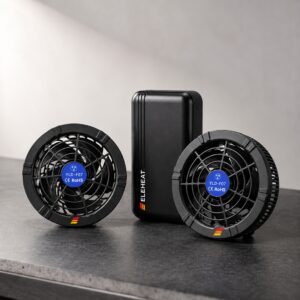
- Battery fan kits for fixed posts and campsite duty.
Frequently asked questions
How long does cooling last on a full-day event?
Water circulation vests run 4-8 hours per fill, about 4 hours at 35 C. PCM packs run 2-4 hours per set and are swapped between crews. Fan kits run 8-12 hours at low speed, and Peltier vests run 3-5 hours on a 20,000 mAh pack. Plan one spare per person.
Can a cooling vest be worn under a backpack or harness?
Water circulation and PCM vests use a low-profile layout so a pack, radio harness, or hydration bag can sit over them, provided the load does not press on the pump housing. Fan kits are better mounted on the outer layer. Send your harness layout and we will confirm fit before production.
Do these systems need a battery?
Not all of them. Evaporative vests and PCM packs need water or a freezer and no power at all. Water circulation vests run on a small rechargeable pump. Only Peltier vests and fan kits depend on battery capacity, and both ship with CE battery packs covered by a 12-month warranty.
What are MOQ and lead times for a group order?
MOQ is 50 sets for stock models and 200 sets for custom color or logo. Samples take 7-10 days, and bulk production takes 25-35 days. Monthly capacity is 80,000-120,000 sets from a 12,000 m2 factory with 700 staff and an ISO 9001 quality system.
Tell us the activity, hours in the sun, and headcount, and we will recommend a system with a realistic runtime plan.
Models for this scenario
Recommended products
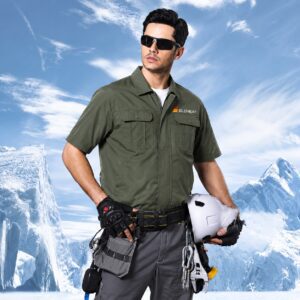
12V Boost Cable Air Conditioned Vest for Men, Summer Cooling Fan Workwear, Single Top
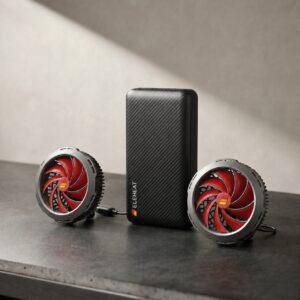
24V Cooling Garment Battery Fan Set | 30000mAh, 9-Blade Silent Brushless Fan CE Certified
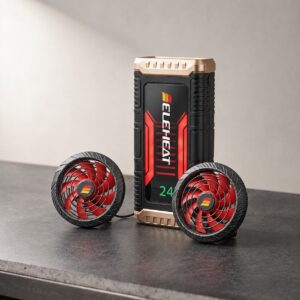
24V High Speed Brushless Fan & Battery Accessories Kit for Cooling Work Clothes
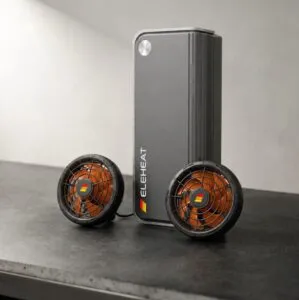
24V Special Battery Fan Kit for Cooling Work Clothes, 4 Speed Silent Brushless Waist-hung Fan
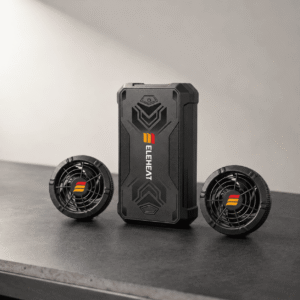
30V 24000mAh Lithium Battery Kit | Powerful Brushless Fan for Cooling Work Garments